我们的少年时代
China-SK flights stay at high level amid network expansion, rising demand_我的网站

一 | A nearly 4,000-words long essay published in the peer-reviewed journal Qualitative Research in April has recently attracted quite a bit of attention and scrutiny after going viral on Twitter.,The paper is authored by Karl Andersson, a PhD student at the School of Arts, Languages and Cultures at The University of Manchester, and is titled “I am not alone – we are all alone: Using masturbation as an ethnographic method in research on shota subculture in Japan”, with “shota” being defined by the author himself as a “Japanese genre of self-published erotic comics that features young boy characters.”,“In this research note, I will recount how I set up an experimental method of masturbating to shota comics, and how this participant observation of my own desire not only gave me a more embodied understanding of the topic for my research but also made me think about loneliness and ways to combat it as driving forces of the culture of self-published erotic comics,” Andersson wrote.,According to Vice News, the essay essentially amounts to the description of the author’s “masturbation habits” and thoughts and feelings while reading the comics in question, as well as “defenses of all of the above as legitimate research.”,Lots of generative discussion on this new piece of research at #ASA2022. pic.twitter.com/DZ7bEY9Akq— Tim Gill (@timgill924) August 9, 2022,As the paper got more and more attention online, many sociologists and researchers decried it as “deeply problematic, embarrassing, and even dangerous to the field”, with some even initially suspecting that it was a joke, the media outlet notes.,“While sexuality researchers have written about masturbation, this is the first I have heard of masturbation as a methodology, let alone masturbation to depictions of children,” Andrea Becker, postdoctoral research fellow studying sexual and reproductive health at the University of California, San Francisco, told Vice. “It is a misrepresentation of qualitative work, of sociology, and of sexualities research.”,Justin Gutzwa, a postdoctoral scholar at the University of Utah who researches gender, sexuality, and transphobia in education, also wondered aloud “what was the review process for this article like”.,“I’m mystified that any reviewer would pass off on this as an exemplar of innovative ethnographic methods, let alone an acceptable, appropriate, or ethical piece of writing,” he remarked.,Qualitative Research has announced that they launched an investigation into the publication on 9 August.,The media outlet also points out that Andersson’s fascination with “shota” appears to be well-documented, and that this particular genre is actually illegal in the UK – where he “goes to school” – as well as in several other countries.。
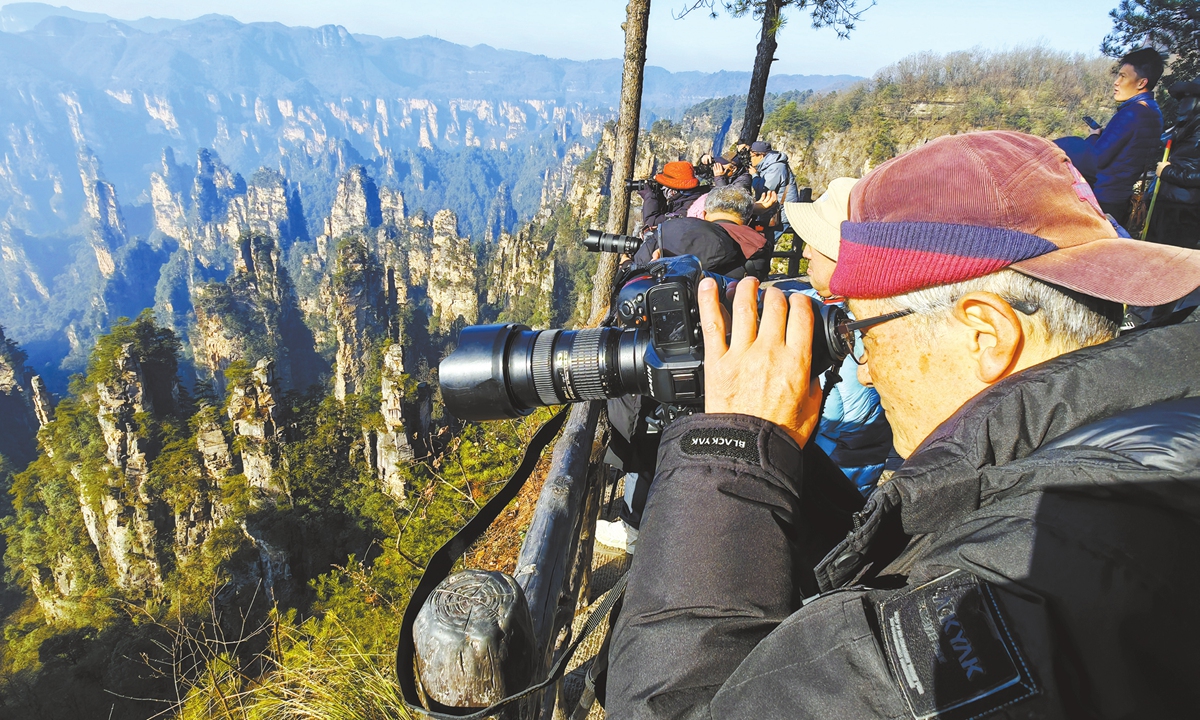
A South Korean senior citizen (right), joining a photography group, tours and takes photos at Zhangjiajie National Forest Park in Central China's Hunan Province, on January 5, 2025. Photo: VCG
Flights between China and South Korea remained at a high level in the past two weeks, supported by network expansion and rising demand, industry data showed on Monday.
Between July 27 and August 9, a total of 5,142 passenger flights were operated on China-South Korea routes, maintaining a high level of overall supply, industry data provider VariFlight told the Global Times on Monday.
Compared with the previous period from July 13 to July 26, when there were 5,145 flights, the number of operated flights decreased by just three, remaining essentially flat.
Compared with the same period in 2025, the number of flights grew by 10.7 percent. Flight operations during this period grew by 12 percent compared with the same period in 2019, indicating that current passenger flight volumes on China-South Korea routes have significantly surpassed pre-pandemic levels, VariFlight said.
The rising demand is also supported by more airlines and airports expanding their networks.
For example, Spring Airlines said that its current network includes four South Korean destinations: Jeju, Busan, Cheongju, and Seoul.
Following the introduction of the visa-free policy for South Korean passport holders, the carrier has witnessed a notable uptick in weekend trips to Shanghai, with Friday arrivals seeing a particularly strong uptrend. On the Busan-Shanghai route, Korean travelers have made up as much as 80 percent of passenger loads on Friday and Sunday flights during peak travel windows, Spring Airlines told the Global Times on Monday.
Jeju Air saw its passenger traffic increase by nearly 40 percent year-on-year during the first seven months of this year on routes between the two countries, the Yonhap News Agency reported on Monday.
From January to July, seat capacity on Jeju Air's South Korea-China routes grew by 26.8 percent year-on-year to 494,300 seats, while passenger traffic rose by 37.4 percent year-on-year to 427,300 travelers, and the load factor climbed 6.6 percentage points to 86.4 percent.
Eastar Jet, a South Korean low-cost carrier, announced on Friday that it had launched a new route between Incheon and Hohhot with two flights per week, Yonhap reported.
The expansion of flight routes between China and South Korea is a reflection of both warming bilateral relations and rising demand in tourism, business, investment, and people-to-people exchanges, Da Zhigang, a researcher at the Heilongjiang Provincial Academy of Social Sciences' Institute of Northeast Asian Studies, told the Global Times.
He said that visa-free policies and travel facilitation measures, with tourism acting as a bridge for broader exchanges and trade, have paved the way for this expansion.
Data from Qunar.com showed that South Korea ranked first in the inbound source market rankings for the first half of 2026, followed by Thailand, Singapore, and Vietnam.
While South Korea is already China's largest source of foreign tourists, even more of its nationals have been making trips to their western neighbor in recent months. About 1.7 million South Koreans visited China in the first half of this year, up 16 percent from the same period last year, scmp.com reported on Saturday, citing figures from South Korea's Ministry of Justice.
Yanji Chaoyangchuan International Airport expanded its South Korean route network to six destinations including Busan, Cheongju and Daegu with 668 monthly flights and a daily peak of 26 flights carrying 4,115 passenger trips in July. The airport ranked first in Northeast China for South Korean passenger traffic in July.
On May 16, Qingdao Airlines increased the frequency of its Qingdao-Seoul route, with flights operating three times per week. After this increase, average daily passenger flights from Qingdao to South Korea reached 18, of which 16 served Seoul on a daily basis.
。

二 |
Current article:http://1k9qfoi.recuigoutoubaozukai.pics/3losd/20260826/4402.html
Published on:05:02:00