
荡寇风云
多家中小银行,取消通知存款自动转存业务_我的网站

一 |
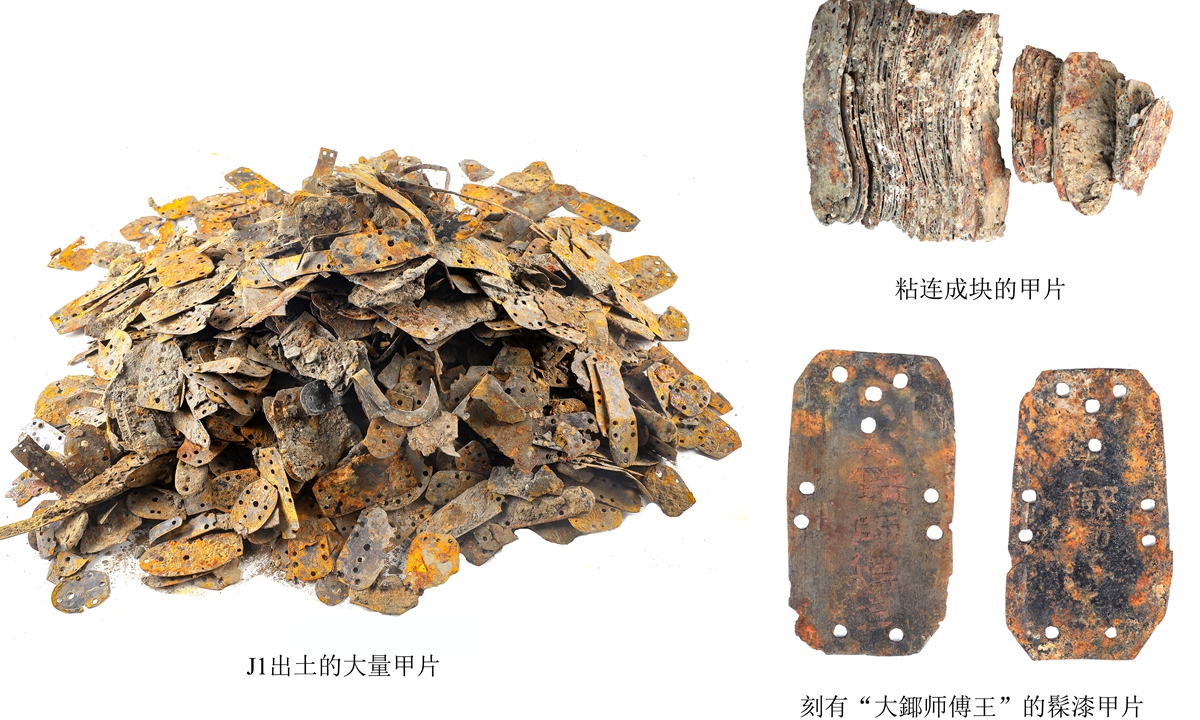
While China has a long history of making tinned bronze and tinware, there has long been a lack of reliable historical records or physical evidence to prove early local production of tinned iron artifacts. The newly discovered armor plates can fill this gap, demonstrating that, by no later than the Wu period, local craftspeople in Zhejiang Province had mastered the art of tin-plating iron surfaces. This reflects the region's advanced metallurgical skills at that time, Ge Shuaikun, a researcher at the Shaoxing Institute of Cultural Relics and Archaeology, told the Global Times on Tuesday.
Over the last three years, archaeologists working at the Jizhong ruins site have excavated hundreds of tinned iron armor plates from ancient wells and ash pits. A preliminary investigation confirmed that the surfaces of these plates contain high levels of tin. Subsequent laboratory analyses were conducted in collaboration with the Shaoxing's institute and the Institute for Cultural Heritage and History of Science & Technology at the University of Science and Technology Beijing with methods such as Scanning Electron Microscopy with Energy Dispersive Spectroscopy (SEM-EDS), X-ray Diffraction (XRD), and Micro-CT to deeply examine the samples' materials, structures, and technological traces.
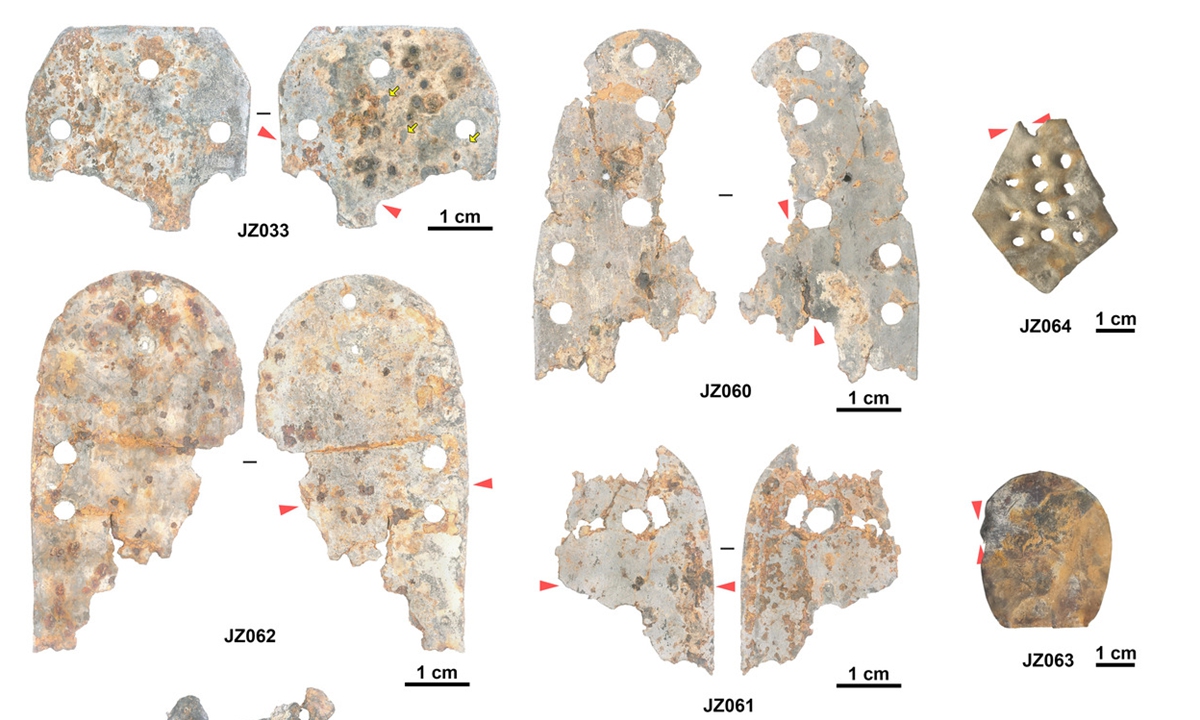
Research shows that the craftspeople immersed iron armor plates in molten tin, thus ensuring complete coverage of the surface with a continuous tinned layer. This coating isolated the iron from exposure to air and moisture, dramatically boosting corrosion resistance. Many of the excavated tinned armor pieces still show a clear, bright silver-white finish.
One major reason for tin-plating the armor was to prevent rust. At the same time, the silvery white shine of tinned iron offered a more striking, beautiful appearance, standing out from the typical dark iron armor of the era. This visual distinction may have marked these pieces as a higher-grade military asset, according to an article from the University of Science and Technology Beijing's official website.
The article said that in earlier eras, from the pre-Qin to Han dynasties, tin was widely used as a surface coating on bronzeware and ceramics. Researchers believe the tin-plating of iron armor discovered at the Jizhong ruins site during the Wu period of Three Kingdoms built upon this local tin-coating tradition, representing an adaptation of those techniques across different materials. The process likely benefited from technological exchange among various specialized workshops at the site, including those making bronze castings, iron weapons, and other metallurgical products.
。 本文来自微信公众号:财联社 (ID:cailianpress),作者:彭科峰 又见中小银行取消通知存款自动转存业务。 昨日下午,贵州务川农商银行发文称面对通知存款产品进行调整,已于10月17日取消通知存款产品的主动转存功能。

二 | 今日,财联社记者查询发现,仅在贵州省内近期已经有超十家银行机构发布此类公告。此外,近期北京银行也在官网发文,自10月起新办理的单位通知存款,原则上挂钩北京银行挂牌利率。

三 | 在业内人士看来,此举是为了响应监管部门关于落实通知存款、协定存款利率自律要求的结果。相比中小银行,绝大部分国有行、股份行和上市城商行已经于去年下半年率先调整,取消了此类高息存款产品的自动转存功能。 贵州省内多家银行相继发声通知存款不再自动转存 昨日,务川农商银行发布了关于调整部分存款产品的公告。在公告中,该行表示,为贯彻落实相关监管要求,进一步维护市场竞争秩序,“我行对通知存款、零存整取类产品进行调整。”其具体内容包括:于10月17日取消通知存款产品的自动转存功能,且办理支取产品前,需要通过该行任一网点或者电子渠道提前一天或者七天登记预约支取信息,避免资金造成损失。 财联社记者查询发现,除了务川农商银行外,近期贵州省内还有赤水农信联社、万山长征村镇银行榕江农信联社等超十家农商行、村镇银行、农信联社等中小金融机构发布了类似通知。并且,这些金融机构基本都属于贵州省农信联社系统。 除了这些地方银行,近期北京银行也发布了涉及通知存款的业务调整信息。

四 | 9月底,北京银行在官网发布的公告显示,为更好适应存款利率市场化改革要求,该行将调整单位通知存款利率结构。自2025年10月1日起,新办理的单位通知存款原则上挂钩北京银行挂牌利率(可在挂牌利率基础上进行加减点调整),单位通知存款存续期内如遇挂牌利率调整,自动分段计息。 此外,年内还有汉口银行等地方银行发布了中止类似特色储蓄存款产品的公告,将“本息到期后不进行自动转存”调整为“在当前存期的到期日,系统自动转存到期本息,按照当期转存日该产品执行利率计息” “通知存款本质上是银行此前开发出来的一款揽储工具。

五 | ”某券商银行业分析师告诉财联社记者,贵州多地中小银行和北京银行的业务调整,实际上都是进一步降低了通知存款的利率,将其挂钩活期。

六 | 大行去年下半年已集中调整高息存款不再能否助力“存款搬家” 财联社记者采访业内人士了解到,通知存款尤其是智能通知存款因为期限灵活,又能产生一定程度的利率上调,此前颇受部分低风险客户的喜爱。

七 | 但在监管部门遏制银行存款定价无序竞争的背景下,去年下半年,六大国有行和绝大部分的股份行、城商行均已经率先叫停了通知存款的自动转存功能,部分大行还直接下架了智能通知存款产品。不过,部分存量产品可能存在未到期的可能,其到期后也会自然终止。 “我行已经于去年直接叫停了此类业务,目前智能通知存款产品已经下架了。”今日,某上市城商行相关人士告诉财联社记者。目前来看,地方中小银行的动作明显更慢一些。 相关银行人士告诉记者,整体来看,今年银行的息差压力进一步扩大,为了降低负债成本,银行有进一步压缩高息存款产品的动力。但对中小银行而言,在揽储压力下,也不得不在发行大额存单等方面“另寻路径”。在银行业内卷化尚未结束的背景下,不排除一些高息产品会阶段性死灰复燃。 “高息存款的消失和定期存款利率的不断下调,客观上有利于银行进一步降低负债,并驱使部分客户的存款向银行理财、黄金投资等方向转化。”上述分析师则表示,从宏观的维度来看,此举或许会对“存款搬家”有一定的推动作用。
Current article:http://1k9qfoi.recuigoutoubaozukai.pics/list_ftdbz1h/e5vk.html
Published on:12:18:42